
Written with respect for two leaders who have given this industry a great deal over difficult years, and offered in the spirit of what lies ahead for the rest of us.
Lee McLean announced he was leaving Australian Grape & Wine after four years as CEO. A day later, Dr Mark Krstic announced he was stepping down as managing director of the AWRI after seven years in the role and fifteen years at the institute. Both departures were entirely voluntary, both were handled with dignity, and both men leave with the genuine thanks of their boards and their industry. This isn’t a piece about either of them. It’s a piece about what happens next — because what happens next, if history is any guide, tells us something uncomfortable about how this industry thinks about leadership.
Both boards responded the way boards always respond. AGW will “commence the process of appointing a new CEO.” The AWRI will “start a search for the next managing director.” Standard language, standard process, entirely defensible on its own terms. And also, if you’ve been watching this industry for as long as I have, entirely predictable — because it’s exactly what happened last time, and the time before that.
Here’s the part that should stop us in our tracks. Mark Krstic — the man just stepping down from the AWRI’s top job — is a graduate of the Wine Industry Future Leaders program. Class of 2010. The program that industry has funded since 2006, that has now put more than 150 people through it, that sells itself on “progression of graduates into key leadership roles across the industry.” It worked. It produced the person who has just spent seven years running one of our most important institutions.
And when he was appointed to that job in 2019, the AWRI board still ran what it called “a global search.” When Lee McLean was appointed CEO of AGW in 2022 — after four years already inside the organisation as GM of Government Relations — the board ran “an extensive international search.” When Wine Australia last changed CEOs in 2021, it went to an external recruitment firm for a national process.
Read that again. In every case I can find, the person best placed for the job was already there, in the building, doing the work — and the board’s first instinct was still to go looking for someone else before it would trust what it already had. That’s not a coincidence repeated three times. That’s the culture.
I don’t say any of this to score points off good people who have done hard jobs, well, during the toughest stretch our industry has faced in generations — my thanks to both of them for that. I say it because Krstic and McLean are, between them, the best evidence I have that the system can work exactly as intended — and the clearest illustration that we don’t yet trust it to. We built the escalator. We keep taking the stairs.
It doesn’t have to be this way, and we don’t have to guess at the alternative — we’ve already done it, just not at the top. When Angus Barnes stepped down as executive chair of Wine Communicators of Australia last year, after more than a decade with WCA, there was no global search. Deputy chair Lynda Schenk moved into the chair. Andrew Shedden moved up to fill her seat. Visible, planned, internal, done in a matter of weeks. It’s a smaller organisation and a different kind of role, I grant you — but it proves the industry knows exactly how to do this when it decides to. We just don’t decide to when the job is big enough to matter.
Widen the lens and the pattern holds. SAWIA lost its chief executive in 2025. AGW’s own founding CEO, Tony Battaglene, was also succeeded via an international search rather than a planned internal handover. Four or five of our most senior peak-body roles have turned over in the space of about five years, and every single one has been treated as starting from zero.
I’ve spent forty years in this industry, the last two decades of them thinking hard about succession — inside our own family business, Pridham Viticulture, and through direct involvement in the leadership programs this industry runs. I’ve learned the hard way that succession isn’t an event, it’s a relay — the plan doesn’t end when the baton passes, it just changes hands and keeps moving. Seven years ago I had a plan for my own eventual handover and thought that was enough. It wasn’t.
The plan was sound; what I’d misjudged, like a rookie, was the stakeholder engagement underneath it — the people around that plan who needed to be genuinely part of it, not informed of it. We’ve since built the engagement the plan always needed, and the leadership transfer at Pridham Viticulture is well underway, with a next generation of leaders stepping into roles that will keep being defined as the business evolves. That’s the part boards chasing a global search tend to miss: succession isn’t a hire, it’s a relationship you build years in advance, and it doesn’t finish just because the title changes hands.
So what should change? Not another program. Not another review. A different measure of success for the people who hold these roles in the first place.
Right now, we measure a good CEO or a good managing director by how long they hold on, how steady they keep the ship, how gracefully they eventually let go. I’d argue we’ve got that backwards. The real measure of a good leader in an industry-funded, industry-serving role is whether they’ve made their own position redundant by the time they leave it — whether there’s someone standing in the wings who doesn’t need a global search to be found, because everyone in the building already knows who it is.
Succession shouldn’t be the last six months of a departing leader’s tenure. It should be a standing item on every peak-body board’s agenda, every year, the same way ASX boards are expected to keep a live view of who’d step up tomorrow if the CEO’s chair emptied overnight. Future Leaders and its equivalents should be judged on the same measure — not “how many people have been through the program,” but “how many are actually sitting in the chairs that matter now,” published, tracked, and reported the way any other investment of industry levy money would be.
None of this requires us to think less of Lee McLean or Mark Krstic. If anything it requires us to think more of what they’ve proven is possible. Krstic didn’t just run the AWRI well for seven years — he is, himself, the proof that a homegrown pipeline can produce a genuine leader. The question this industry now has to answer isn’t whether we can develop good people. We’ve already shown we can. It’s whether we’re prepared to trust the people we’ve developed enough to stop starting every search from zero.
We’re not short of leaders in this industry. We’re short of boards willing to bet on the ones we’ve already built.
This isn’t a question for the leaders stepping down.
It’s a question, now, for the rest of us.
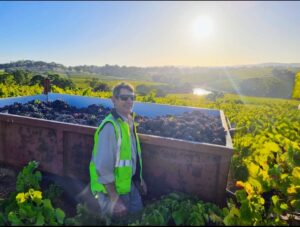
Authored By
Ben Pridham
CEO, Pridham Viticulture